
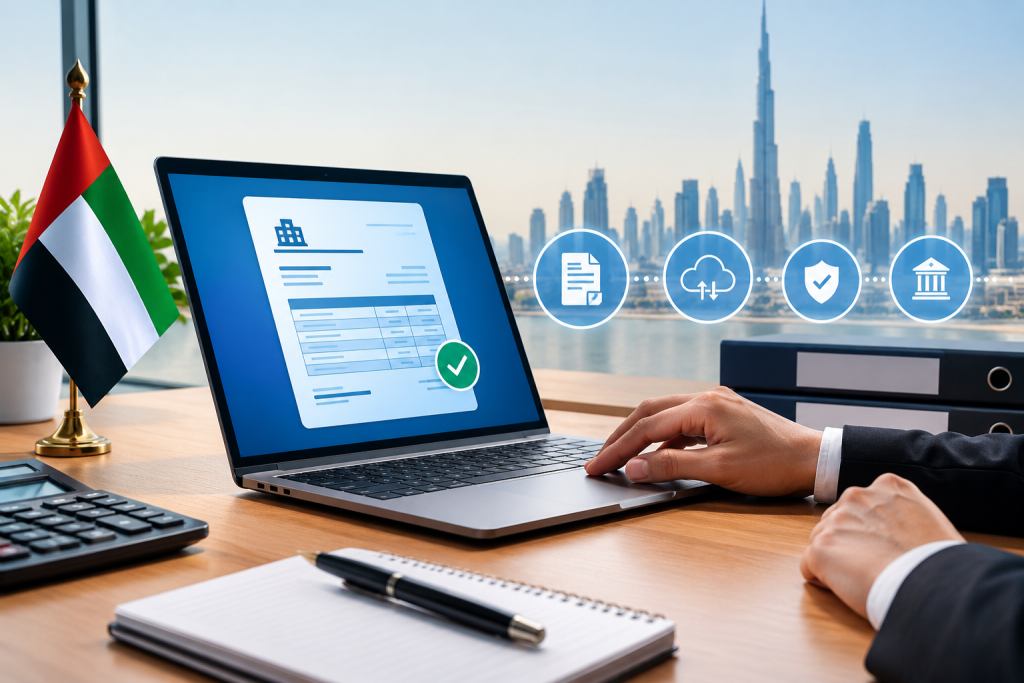

UAE E-Invoicing is becoming an important requirement for businesses operating in the United Arab Emirates. As the UAE moves toward a more digital and transparent tax environment, businesses need to understand the new UAE E-Invoicing regulations, implementation requirements, and important deadlines.
The UAE E-Invoicing system is designed to modernize the way businesses issue, exchange, and report invoices. Instead of relying primarily on traditional paper invoices or invoices shared through email, businesses will progressively move toward structured electronic invoices that can be exchanged through approved digital systems.
For businesses of all sizes, understanding UAE E-Invoicing early can make the transition easier. Companies that start preparing their accounting systems, invoicing processes, tax information, and digital infrastructure in advance can reduce the risk of compliance issues and operational disruption.
In this guide, we explain what e-invoicing means, who needs to prepare, the expected UAE E-Invoicing deadlines, key requirements, benefits, implementation steps, and what businesses should do next.
Table of Contents
What Is UAE E-Invoicing?
UAE E-Invoicing refers to the electronic creation, exchange, and processing of invoices in a standardized digital format. The e-invoicing framework is intended to create a more efficient and transparent invoicing environment for businesses and tax authorities.
Unlike a simple PDF invoice sent by email, a compliant electronic invoice contains structured data that can be processed electronically. This allows invoice information to move between businesses and approved systems in a standardized manner.
The introduction of e-invoicing is part of the country’s wider digital transformation strategy. It is also expected to improve the quality and availability of transaction data while reducing manual processes associated with traditional invoicing.
Businesses should therefore understand that UAE E-Invoicing is more than simply converting a paper invoice into a PDF.
Why Is E-Invoicing Being Introduced?
The UAE E-Invoicing initiative is designed to improve the efficiency of business transactions and create a more standardized digital invoicing environment.
There are several reasons why e-invoicing is important:
- Better digital record keeping
- Faster invoice processing
- Reduced manual data entry
- Improved transaction transparency
- More efficient tax reporting
- Reduced administrative work
- Better integration between accounting systems
- Improved accuracy of invoice information
For businesses, the move toward e-invoicing can also create an opportunity to automate finance and accounting workflows.
Companies that currently manage large numbers of invoices manually may be able to reduce repetitive work by connecting their accounting, ERP, and invoicing systems to compliant e-invoicing solutions.
UAE E-Invoicing Regulations: What Businesses Should Know
The e-invoicing regulations introduce a structured framework for businesses to move from conventional invoicing processes toward e-invoicing. For official updates, guidelines and the list of accredited service providers, refer to the UAE Ministry of Finance e-invoicing portal and the Federal Tax Authority.
Businesses should pay attention to several areas when preparing for UAE E-Invoicing, including:
- Invoice format
- Required invoice information
- Approved e-invoicing service providers
- Accounting and ERP system compatibility
- Digital invoice exchange
- Data storage and record keeping
- Tax compliance
- Implementation deadlines
The exact obligations can depend on the type and size of the business, the nature of its transactions, and whether the business falls within the relevant scope of the e-invoicing framework.
For this reason, companies should evaluate their own invoicing processes rather than assuming that one implementation approach will work for every business.
E-Invoicing Deadline: When Should Businesses Prepare?
One of the most important questions businesses have is the UAE E-Invoicing deadline.
The UAE is implementing e-invoicing through a phased approach. Businesses should therefore avoid waiting until the final compliance date before beginning preparation.
The e-invoicing rollout involves different stages covering areas such as the selection of e-invoicing service providers, system preparation, and the eventual exchange of electronic invoices.
Because implementation dates and technical requirements can change as the UAE authorities publish additional guidance, businesses should regularly check official UAE tax and government announcements.
Starting preparation early is particularly important for companies that use complex ERP or accounting systems. System changes, testing, data mapping, and employee training can take time.
Who Will Be Affected by UAE E-Invoicing?
E-invoicing is relevant to businesses that issue and receive invoices as part of their commercial activities.
The impact can vary depending on the business structure and transaction type. Businesses that should begin reviewing their processes include:
- UAE-based companies
- VAT-registered businesses
- Companies issuing business-to-business invoices
- Companies involved in business-to-government transactions
- Businesses using ERP systems
- Companies with large volumes of invoices
- Businesses operating across multiple entities
- Companies using manual invoicing processes
Even businesses with relatively simple accounting processes should evaluate their readiness for e-invoicing.
The first step is to understand how invoices are currently created, approved, exchanged, recorded, and stored.
UAE E-Invoicing vs PDF Invoices
A common misunderstanding is that sending a PDF invoice by email is the same as e-invoicing.
It is not necessarily the same.
A PDF invoice is generally designed for people to read. An electronic invoice is structured so that invoice data can be automatically processed by compatible systems.
For example, a structured electronic invoice may contain information such as:
- Supplier details
- Customer details
- Tax registration information
- Invoice number
- Invoice date
- Product or service details
- Quantity
- Price
- VAT information
- Total invoice value
The objective of UAE E-Invoicing is to make invoice information machine-readable and easier to exchange between systems.
Key E-Invoicing Requirements
Businesses preparing for e-invoicing should review their existing invoicing infrastructure.
Important areas include:
1. Business and Tax Information
Companies should make sure their business information and tax-related data are accurate across their accounting and invoicing systems.
Incorrect company names, tax registration information, addresses, or customer information can create problems when invoices are processed electronically.
2. Invoice Data
Businesses should review the information currently included on their invoices and determine whether their systems can produce all required data in the appropriate structured format.
3. Accounting Software
Your accounting software should be capable of supporting the required UAE E-Invoicing processes.
Companies using older or highly customized accounting systems may need additional development or integration.
4. ERP Integration
Large businesses may need to integrate e-invoicing functionality with their ERP systems.
This can involve systems such as accounting platforms, enterprise resource planning software, billing systems, and other financial applications.
5. Electronic Invoice Exchange
Businesses will need to understand how electronic invoices are exchanged between the relevant parties through the approved framework.
6. Record Keeping
Companies should also review their invoice storage and record-keeping procedures to ensure that electronic invoice information can be retained and retrieved when required.
How Will UAE E-Invoicing Work?
The e-invoicing model is designed around the electronic exchange of structured invoice data.

Instead of creating an invoice and simply sending a PDF through email, the business’s accounting or ERP system can generate structured invoice information.
That information can then be processed through the relevant e-invoicing infrastructure before reaching the recipient.
A simplified process can look like this:
Business → Accounting/ERP System → E-Invoicing Service Provider → E-Invoicing Network → Customer
The exact technical implementation will depend on the final requirements and the systems used by the business.
Benefits of E-Invoicing for Businesses
Although UAE E-Invoicing introduces new compliance requirements, it can also provide significant benefits.

Faster Invoice Processing
Electronic invoices can reduce the amount of manual work required to create, send, receive, and process invoices.
Fewer Manual Errors
Automated invoice data can reduce errors caused by manually entering invoice information into accounting systems.
Better Cash Flow Management
Faster invoice processing and improved visibility can help businesses manage receivables more efficiently.
Improved Accounting Automation
E-invoicing can help businesses connect invoicing with accounting and ERP systems.
Better Compliance
Structured invoice data can make it easier for businesses to maintain consistent records and support tax compliance processes.
Reduced Paperwork
Moving from paper-based processes to digital invoicing can reduce printing, scanning, filing, and physical storage requirements.
Get Your Business Ready for UAE E-Invoicing with TallyPrime
Arabian Crescent is a trusted TallyPrime partner in Dubai. Our certified team can check your current invoicing setup, upgrade your TallyPrime, and guide you step by step towards e-invoicing compliance — so you never miss a deadline.
How Businesses Can Prepare for UAE E-Invoicing
Businesses should begin preparation well before their applicable e-invoicing deadline.

Here is a practical preparation checklist.
Step 1: Review Your Current Invoicing Process
Document how invoices are currently created, approved, sent, received, and stored.
Identify which steps are manual and which are automated.
Step 2: Identify Your Accounting Systems
Make a list of the accounting, ERP, billing, CRM, and other systems that currently handle invoice information.
Step 3: Review Your Invoice Data
Check whether your current invoices contain accurate and complete business, customer, tax, product, and payment information.
Step 4: Check Software Compatibility
Speak with your accounting software or ERP provider to understand how they plan to support e-invoicing.
Step 5: Evaluate E-Invoicing Service Providers
Businesses should evaluate suitable e-invoicing service providers and understand how the providers will integrate with existing systems.
Step 6: Prepare Your Team
Finance, accounting, sales, procurement, and IT teams may all be affected by the transition.
Employees should understand how the new UAE E-Invoicing workflow will work.
Step 7: Test Before Going Live
Businesses should test invoice generation, data transmission, invoice receiving, error handling, and record keeping before the system becomes mandatory for their organization.
Common E-Invoicing Challenges
The transition to UAE E-Invoicing may create challenges for businesses that rely heavily on manual processes.
Common challenges include:
- Outdated accounting software
- Lack of system integration
- Incorrect customer data
- Incomplete tax information
- Manual invoice approval
- Multiple accounting systems
- Limited IT resources
- Employee training requirements
- Data migration
- Testing and troubleshooting
Businesses can reduce these challenges by starting the preparation process early.
E-Invoicing for Small Businesses
Small businesses may assume that e-invoicing is primarily a concern for large companies.
However, small and medium-sized businesses should also understand how the new system may affect their invoicing processes.
Small businesses should review their accounting software, invoice formats, customer information, VAT information, and record-keeping processes.
Businesses that currently create invoices manually may need to move toward software-based invoicing and digital processes.
Early preparation can help small businesses avoid last-minute software changes and operational disruption.
UAE E-Invoicing for Large Businesses
Large organizations typically have more complex invoicing processes.
They may operate multiple entities, branches, ERP systems, currencies, customer databases, and approval workflows.
For these businesses, e-invoicing implementation may require coordination between:
- Finance teams
- Tax teams
- IT teams
- Procurement teams
- Sales teams
- ERP providers
- E-Invoicing service providers
Large organizations should therefore treat UAE E-Invoicing as a cross-functional project rather than simply an accounting software update.
How E-Invoicing Can Support Digital Transformation
E-invoicing is part of a broader move toward digital business operations.
When e-invoicing is connected with accounting, ERP, payment, and reporting systems, businesses can create more automated financial workflows.
For example, a business could potentially automate processes such as:
Order → Invoice → Electronic Exchange → Accounting → Payment Tracking → Reporting
This can provide finance teams with better visibility and reduce repetitive administrative tasks.
UAE E-Invoicing Checklist for Businesses
Before implementing e-invoicing, businesses should consider the following checklist:
- Understand the applicable UAE E-Invoicing requirements
- Identify your applicable implementation deadline
- Review your current invoicing process
- Check accounting software compatibility
- Review ERP integration requirements
- Verify business and tax information
- Review invoice data fields
- Evaluate e-invoicing service providers
- Prepare internal teams
- Test the invoicing workflow
- Establish electronic record-keeping procedures
- Monitor official UAE regulatory updates
What Businesses Should Do Now
Businesses should not wait until the e-invoicing deadline approaches to start preparing.
A good starting point is to conduct an internal invoicing audit.
Ask the following questions:
How are invoices currently created?
Where is invoice data stored?
Which accounting or ERP system is being used?
How are invoices sent to customers?
How are received invoices processed?
Can the existing system support structured electronic invoices?
What changes will be required?
Answering these questions will help businesses identify potential gaps before implementation.
Not Sure Where to Start? Talk to a TallyPrime Expert Today
Get a free consultation and live TallyPrime demo for your business. We help UAE companies with TallyPrime licences, VAT and e-invoicing setup, data migration, training and ongoing support.
Frequently Asked Questions About E-Invoicing
What is UAE E-Invoicing?
E-invoicing is the electronic creation, exchange, and processing of structured invoice data through the UAE’s e-invoicing framework.
Is a PDF invoice considered UAE E-Invoicing?
A PDF invoice sent by email should not automatically be treated as a compliant electronic invoice. E-invoicing is based on structured electronic invoice data that can be processed by systems.
When is the E-Invoicing deadline?
The UAE E-Invoicing rollout is being implemented in phases. Businesses should verify the applicable deadline based on the latest official guidance and their business circumstances.
Do small businesses need to prepare for E-Invoicing?
Small and medium-sized businesses should review the UAE E-Invoicing requirements applicable to them and prepare their accounting and invoicing systems accordingly.
Does E-Invoicing require new software?
Some businesses may be able to update their existing accounting or ERP systems, while others may need an integration or an e-invoicing service provider.
Why should businesses prepare early for E-Invoicing?
Early preparation gives businesses time to review their systems, correct data, integrate software, train employees, test workflows, and address technical problems before their applicable deadline.
Conclusion
UAE E-Invoicing represents an important change in the way businesses manage invoices and financial transactions in the UAE. Companies should understand the e-invoicing regulations, applicable deadlines, technical requirements, and system changes well in advance.
The transition to UAE E-Invoicing can initially appear complex, particularly for businesses using manual invoicing or older accounting systems. However, early planning can make the implementation process significantly easier.
Businesses should start by reviewing their current invoicing processes, checking their accounting and ERP systems, validating their tax and customer information, and understanding the requirements that apply to them.
Most importantly, companies should continue monitoring official UAE announcements because implementation timelines and technical guidance can be updated as the e-invoicing framework develops.
Preparing early for e-invoicing can help businesses improve compliance, reduce manual work, increase invoice processing efficiency, and build a more digitally connected financial operation.